
 how-to
Can You Fix Chronic Desk Job Shoulder Tension?
Last Updated: October 25, 2026
Quick Summary
You can fix chronic desk job shoulder tension by changing the workstation setup that creates it, then rebuilding the muscles that hold you upright. Stretching alone won't fix chronic shoulder tension, so fix monitor height, chair support, and sitting position first, then follow a progressive routine.
- Stand and move every 30 to 45 minutes, using a timer because willpower fails.
- Stage 1 lasts weeks 1-2 with gentle mobility; Stage 2 adds strength in weeks 3-4.
- Raise a laptop on a stand and add an external keyboard and mouse.
- Expect steady change over four to six weeks, not days.
- See a doctor for numbness, tingling, weakness, night pain, or pain after injury.
Table of Contents
- Why Desk Work Leaves Your Shoulders Permanently Tight
- Desk Ergonomics for Shoulder Pain: Set Up Your Workstation First
- How Often to Take Breaks From Sitting (and What to Do in Them)
- Shoulder Stretches for Desk Workers: A Progressive Routine
- Non-Postural Contributors: Stress, Workload, and Sleep
- Tracking Progress: What Improvement Actually Looks Like
- When to See a Doctor for Shoulder Pain
- Book a Therapeutic Massage at Gifted Hands Day Spa
- Frequently Asked Questions
Why Desk Work Leaves Your Shoulders Permanently Tight
Chronic desk job shoulder tension is the steady buildup of tightness in the neck, upper back, and shoulder muscles caused by hours in one fixed position.
Here's the part most guides get wrong. Stretching alone won't fix chronic shoulder tension. You have to change the setup that creates it, then rebuild the muscles that hold you upright.
Muscular Tension vs. Something Else
Not all shoulder pain is muscle tension.
Desk Ergonomics for Shoulder Pain: Set Up Your Workstation First
Desk ergonomics for shoulder pain starts with one rule: bring the work to your body, not the other way around.
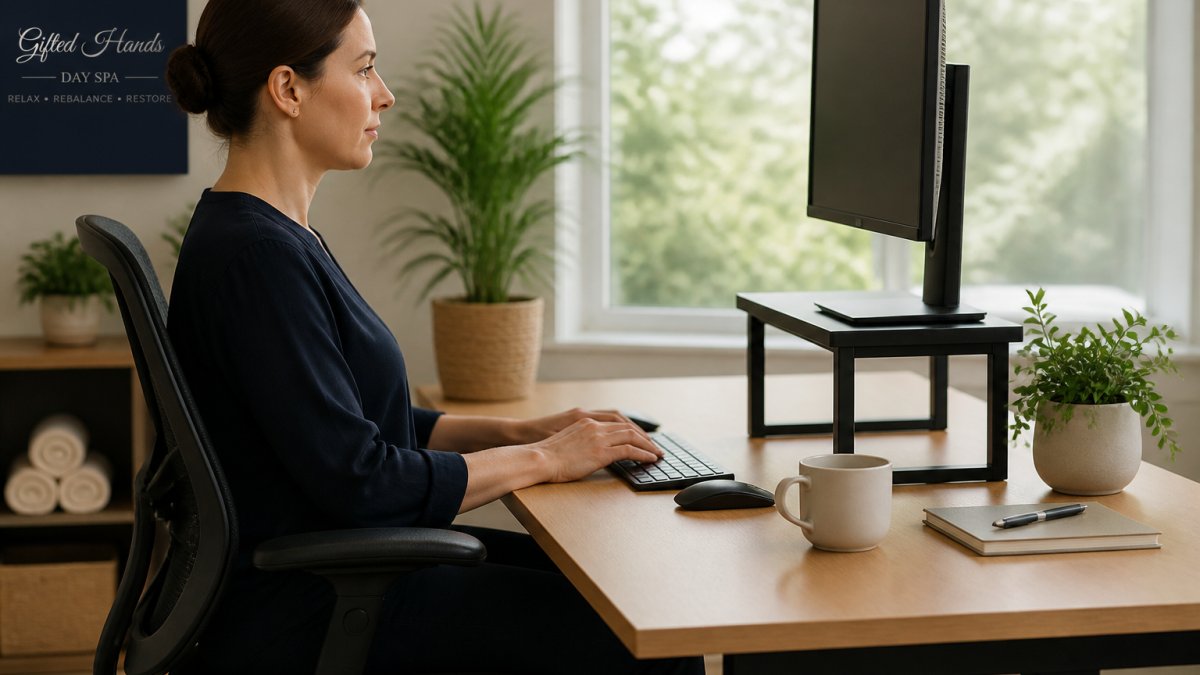
Monitor Height, Chair Support, and Sitting Position
Fix these three things before you stretch a single muscle.
- Monitor height: The top of the screen should sit at eye level. If you look down, your neck bends forward and your shoulders round. A stack of books works as well as a monitor stand.
- Screen positioning: Place the screen an arm's length away, directly in front of you. Twisting to see a side monitor tightens one shoulder all day.
- Chair support: Adjust lumbar support so your lower back stays curved. Set armrests so your shoulders drop instead of hunching up.
- Sitting position: Feet flat on the floor, hips slightly higher than knees, elbows near 90 degrees. Keep shoulders relaxed and down, not pinched back.
The best ergonomic setup is one you notice less. If you're thinking about your posture all day, it's still wrong.
How Often to Take Breaks From Sitting (and What to Do in Them)
Stand and move every 30 to 45 minutes. Set a timer, willpower fails; alarms don't. Breaks don't need to be long: a two-minute walk to refill your water resets the shoulder muscles and restores blood flow.
- Stand up and roll your shoulders back five times
- Walk to the window and look outside for 20 seconds
- Do a slow shoulder-blade squeeze, holding for five seconds
The pattern matters more than the duration: short, frequent movement beats one long stretch session at day's end.
Short, frequent movement beats one long stretch session, so build these micro-breaks into your day.
| Action | How long or how often |
|---|---|
| Stand and move | Every 30 to 45 minutes |
| Walk to refill water | Two minutes |
| Roll shoulders back | Five times |
| Look out the window | 20 seconds |
| Shoulder-blade squeeze | Hold five seconds |
| Walking break | After every long call or meeting |
Shoulder Stretches for Desk Workers: A Progressive Routine
Shoulder stretches for desk workers work best as a plan, not a random list. Chronic tension built up over months, so give it weeks to unwind.
Before You Start: Pick Your Starting Point
Use this two-minute self-check to choose your entry stage.
- Sit tall and roll your shoulders back five times. Do they move smoothly, or do they catch and grind?
- Tilt your ear toward each shoulder. Note where you feel the stretch and whether one side is noticeably tighter.
- Pinch your shoulder blades together and hold five seconds. Can you hold without your shoulders creeping up toward your ears?
If rolling feels smooth and the squeeze is easy, start at Stage 1 but expect to move to Stage 2 within a week. If you feel catching, one-sided tightness, or your shoulders hike up during the squeeze, stay in Stage 1 longer and add the desk modifications below.
Stage 1 (Weeks 1-2): Gentle Mobility and Awareness
Start small: remind the shoulder muscles what relaxed feels like and build the habit of noticing tension before it becomes an ache.
- Neck stretch: Tilt your ear toward your shoulder. Hold 20 to 30 seconds. Repeat on each side. Keep the opposite shoulder relaxed and down.
- Shoulder rolls: Roll shoulders slowly back five times, then forward five times. Move at a pace where you can feel each part of the circle.
- Side bend: Reach one arm overhead and lean gently to the opposite side. Hold 20 seconds. Keep your hips square so the stretch stays in your side, not your lower back.
Do this once or twice a day. Gentle stretch, no forcing. Pain is a stop sign, not a target.
Stage 2 (Weeks 3-4): Add Strength and Load
Now add strength. Weak upper-back muscles let the shoulders drift forward, so building them keeps tension from returning.
- Resistance band row: Anchor a band at chest height. Pull the band toward your chest, squeezing your shoulder blades. Three sets of ten. Keep your neck long and your shoulders down.
- Longer holds: Hold each Stage 1 stretch five seconds longer than in weeks one and two.
- Core engagement: Add a tall-spine check before each set. A tall spine takes load off the shoulders.
Personalize the Routine to Your Workstation and Body
Your setup and body change what you need. Use these modifications.
- Laptop-only workers: A laptop forces your head down and your shoulders forward. Raise the laptop on a stand or a stack of books and add an external keyboard and mouse. Without that change, no stretch routine will keep up with the daily load.
- Multiple monitors: If you twist to see a side screen, add a gentle chest stretch (place your forearm on a doorframe and step through) and keep the screen you use most directly in front of you.
- One-sided tightness: If one shoulder is consistently tighter, do an extra set of shoulder-blade squeezes on that side and check whether your mouse hand is reaching too far forward.
How to Know the Routine Is Working
Progress in chronic tension is gradual and easy to miss, so track it or you will quit too early. Rate your shoulder tension weekly on a scale of 1 to 10, and note how often you catch yourself hunching, how you sleep, and how quickly tightness eases after a break. Real progress looks like tightness easing faster after breaks, noticing hunching sooner, looser mornings, and the ache no longer following you home.
Non-Postural Contributors: Stress, Workload, and Sleep
Stress, workload, and poor sleep can keep shoulder tension alive even when your desk setup is perfect. Stress makes you hold your shoulders up without noticing.
If stress is the main driver, breathing and grounding exercises help calm the nervous system. You can learn how to calm your nervous system naturally with simple daily resets.
For readers who want to understand which hands-on treatment actually targets deep knots, this guide on the best massage for deep muscle knots explains the options.
Tracking Progress: What Improvement Actually Looks Like
Improvement is gradual and easy to miss. Track it or you'll quit too early.
Rate your shoulder tension once a week on a scale of 1 to 10. Note how often you catch yourself hunching. Note how you sleep.
What real progress looks like:
- The tightness eases faster after breaks
- You notice hunching sooner and correct it
- Mornings start looser
Expect weeks, not days. Most people see steady change over four to six weeks of consistent effort.
When to See a Doctor for Shoulder Pain
See a doctor for shoulder pain if you have numbness, tingling, or weakness in the arm, pain that wakes you at night, or pain that follows an injury. Also seek care if self-care hasn't helped after several weeks. These signs can point to nerve, joint, or other causes that massage and stretching won't fix, and getting checked early saves months of guessing.
Muscular Tension vs. Nerve, Joint, and Other Causes
Muscular tightness usually feels like a band pulling across the top of your shoulders or between your shoulder blades, eases with movement, worsens with long sitting, and is often worse on the side where you hold your mouse or phone.
- Nerve involvement: Numbness, tingling, or weakness down the arm, or pain that shoots into the hand, suggests a nerve is being irritated. Stretching a nerve that is already irritated can make it worse.
- Joint problems: Sharp pain when you lift your arm overhead, a catching or grinding sensation, or pain that wakes you at night can point to a joint issue rather than a muscle one.
- Referred pain: Sometimes shoulder pain comes from the neck. If turning your head or looking up reproduces the shoulder pain, the neck may be the source.
A simple test: roll your shoulders and take a short walk. If the tightness eases, it is more likely muscular. If it does not, or if any of the signs above are present, get assessed.
The Limits of Self-Care
Self-care is the right first step for most desk-related muscular tension, but not for everything. Massage, stretching, and ergonomic changes work on muscles and movement habits; they do not treat nerve compression, joint damage, or medical conditions. If you stretch diligently for weeks with no change, that is not a sign to stretch harder, it is a sign the cause may not be muscular, or the workstation load is still too high for the routine to overcome.
What to Expect From an Assessment
A medical assessment for shoulder pain typically starts with a history of when the pain began, what makes it better or worse, and whether there is numbness or weakness. The clinician will check your range of motion and may test specific movements to see whether the neck or shoulder is the source.
If you are unsure whether your symptoms are muscular, contact us with your questions before booking.
Book a Therapeutic Massage at Gifted Hands Day Spa
Some tension sits too deep for stretching alone. A certified massage therapist can work the shoulder muscles and upper back directly, releasing what your own routine can't reach.
At Gifted Hands Day Spa, our therapeutic massage is tailored to your body, not a script. If you've never had a professional massage, here's what to expect when you book. Ready to start? View our massage therapy services and schedule a visit.
Frequently Asked Questions
How do I relieve chronic shoulder tension from sitting at a desk?
Start with the workstation: raise your monitor so the top of the screen sits at eye level, keep the keyboard close enough that your elbows stay near 90 degrees, and support your lower back so you are not leaning forward. Then add movement breaks every 30 to 45 minutes, even a two-minute walk, plus daily shoulder rolls and a doorway chest stretch held 20 to 30 seconds. Chronic tension usually responds to consistency over weeks, not one big fix. If it persists past a few weeks despite these changes, a professional assessment is the next step.
What shoulder stretches for desk workers actually help?
The most useful ones target the muscles that shorten at a desk: the upper trapezius and chest. Try ear-toward-shoulder side bends held 20 to 30 seconds per side, shoulder rolls in both directions, a doorway chest stretch, and shoulder-blade squeezes where you pinch the blades together and hold five seconds for 10 reps. Do them two or three times a day rather than one long session. Gentle and repeatable beats intense and occasional, especially when tension has built up over months.
How often should I take breaks from sitting, and does a massage really help?
Aim for a movement break every 30 to 45 minutes, even if it is just standing, walking to refill water, or doing a few shoulder rolls. On the massage question: therapeutic massage can ease muscle tension and improve how your shoulders feel and move, but it works best alongside ergonomic changes and daily movement rather than as a standalone fix. Think of it as resetting tissue that desk work keeps tightening, with certified therapists tailoring pressure to what your shoulders actually need.
When should I see a doctor for shoulder pain instead of self-treating?
See a doctor if pain lasts more than two to three weeks despite ergonomic changes and stretching, if it wakes you at night, if you have numbness, tingling, or weakness in the arm or hand, or if you cannot lift your arm through its normal range. Sharp pain after an injury, swelling, or pain accompanied by fever also warrants prompt assessment. Muscular tension typically feels like a dull ache or tightness that eases with movement; anything sharper or one-sided deserves a professional look before you assume it is just desk work.
Chronic shoulder tension rarely fixes itself, and it rarely needs anything dramatic. It needs a better setup, short movement breaks, a routine you actually keep, and sometimes a professional pair of hands. Get started with Gifted Hands Day Spa and give your shoulders the reset they've been waiting for.