 blog
blog
Best Massage for Deep Muscle Knots: What Actually Works
Table of Contents
- Comparing Massage Types for Deep Muscle Knots
- Trigger Point Massage for Muscle Knots: How It Works
- Deep Tissue Massage for Muscle Knots: Benefits and Limits
- How Long Does a Massage for Muscle Knots Take?
- What to Expect After a Deep Tissue Massage
- Self-Massage Techniques for Stubborn Tension
- Contraindications and Safety: When to Avoid Deep Pressure
- Choosing the Right Massage for Your Needs
- Frequently Asked Questions
Last Updated: October 7, 2026
Comparing Massage Types for Deep Muscle Knots
Finding the best massage for deep muscle knots starts with knowing what you're dealing with. A knot is a tight band of muscle fibers that won't relax on its own, a hard pea or rope under the skin that can refer pain elsewhere.
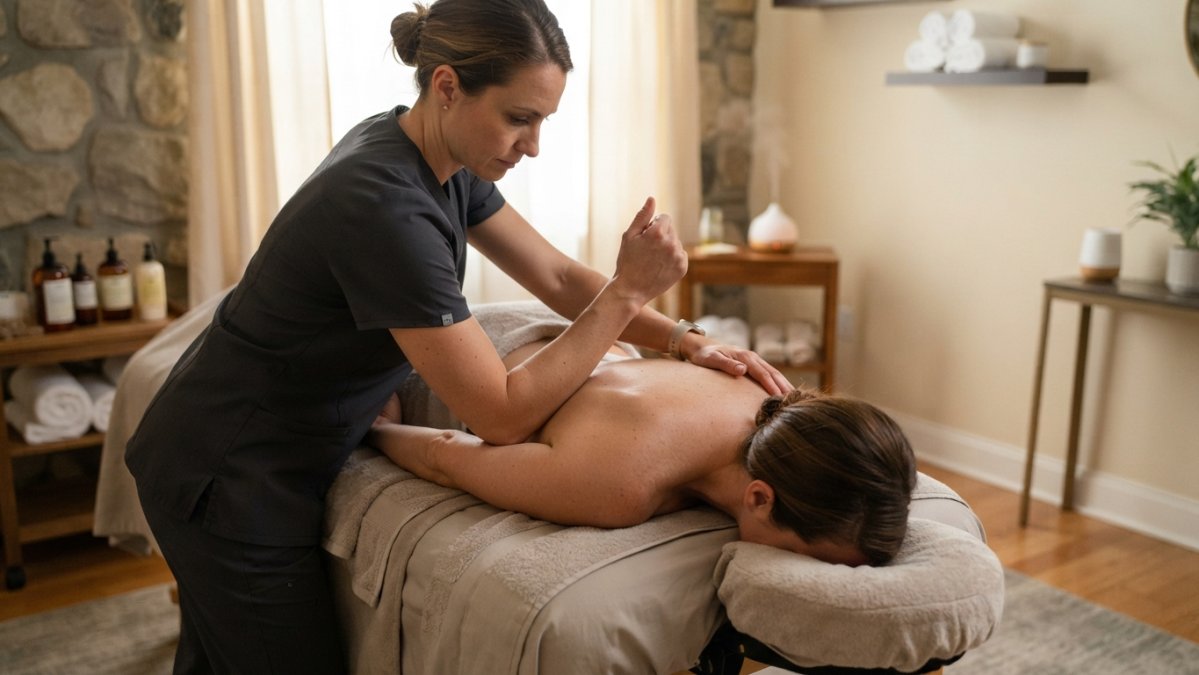
So which massage actually works? The honest answer: it depends on how deep the knot sits and how long it's been there.
Deep Tissue vs. Swedish Massage
Swedish massage is the gentler option: long, flowing strokes with light to medium pressure, aimed at relaxation and stress reduction rather than breaking up adhesions.
Deep tissue massage uses slow, deliberate strokes and sustained pressure to reach deeper muscle layers and connective tissue, the better choice for chronic knots.
The trade-off: deep tissue can feel uncomfortable during the session and leave you sore for a day or two, while Swedish feels wonderful but rarely resolves a knot that's been there for months.
For real muscle knots, deep tissue usually wins.
| Massage Type | Pressure Level | Best For | Typical Soreness |
|---|---|---|---|
| Swedish | Light to medium | Relaxation, stress relief | Minimal |
| Deep tissue | Medium to firm | Chronic knots, adhesions | 1-2 days |
| Trigger point | Focused, sustained | Specific pain points | Localized soreness |
| Sports massage | Varies by goal | Recovery, performance | Varies |
Trigger Point Massage for Muscle Knots: How It Works
Trigger point massage for muscle knots targets specific spots that cause referred pain.
That's the strange part. A knot in your shoulder can cause a headache. A spot near your shoulder blade can make your arm ache.
The therapist finds these points and applies focused, sustained pressure for 30 to 90 seconds. The knot releases. Blood flow returns.
Identifying Muscle Knots and Tension
You can often find your own knots before your appointment. Here's how:
- Press along your shoulder and upper back with two fingers
- Look for spots that feel hard, ropey, or tender
- Note any spot where pressing causes pain elsewhere
A common mistake is assuming all tightness is a knot. Sometimes it's just fatigue. A knot has a distinct, localized feel.
Deep Tissue Massage for Muscle Knots: Benefits and Limits
Deep tissue massage for muscle knots does three things well: it breaks down adhesions between muscle layers, improves circulation to oxygen-starved tissue, and helps restore normal range of motion.
What it can't do is fix the cause. If you sit poorly for eight hours a day, the knot will return. Massage buys you relief and a window to change your habits.
The Science of Myofascial Release
Myofascial release targets the fascia, the connective tissue wrapping every muscle. When fascia gets restricted, it pulls on muscle fibers and creates tension patterns.
Sustained, gentle pressure on restricted fascia encourages it to lengthen. Many therapists blend myofascial release with deep tissue work, and the combination often beats either alone.
Research on massage for pain relief continues to grow. The National Center for Complementary and Integrative Health overview of massage therapy notes that massage may help with pain and muscle stiffness, though study quality varies.
How Long Does a Massage for Muscle Knots Take?
A focused session for muscle knots usually runs 60 to 90 minutes; 30 minutes works for one small area, while full-body deep tissue needs the longer window.
Here's a simple guide:
- 30 minutes: one specific area, like the neck or one shoulder
- 60 minutes: upper body focus, or two to three problem areas
- 90 minutes: full body with extra time on knots
For chronic pain that's built up over months, book the longer session. Rushing deep tissue work helps no one. Your therapist needs time to warm the tissue before applying deeper pressure.
What to Expect After a Deep Tissue Massage
Soreness is normal, usually peaking within 24 hours and fading within two days. You may also feel tired, since massage calms the nervous system and lowers stress hormones.
Drink water. Move gently. Skip intense workouts for a day.
Post-Massage Care and Recovery Time
Recovery varies by person and pressure level. Most feel normal within one to two days; some feel immediate relief with no soreness at all.
To get the most from your session:
- Apply heat to tight areas that evening
- Stretch gently the next morning
- Avoid heavy lifting for 24 hours
The American Massage Therapy Association consumer resources recommends talking with your therapist about aftercare, since needs differ by treatment type.
Self-Massage Techniques for Stubborn Tension
Most guides stop at "book a professional," leaving you helpless between sessions, exactly when knots rebuild. Self-massage won't replace hands-on work, but it extends the window a therapist opens. The trick is matching the tool to the knot's depth and the surface you're working against.
Match the Tool to the Knot
Not every knot needs the same pressure. Think of it as a ladder:
- Tennis ball (about 2.5 inches): best for the upper back, shoulder blade border, and glutes. Its size concentrates force into a small area, which is why it feels sharper than a roller. A lacrosse ball is firmer and roughly the same size, use it only on meaty areas, never on the neck or spine.
- Foam roller (typically 6 inches in diameter, 12-36 inches long): best for broad surfaces like the upper back, lats, and quads. The larger contact area spreads pressure, so it's gentler but less precise. A smooth roller is a good starting point; a knobby one adds intensity but can bruise if you rush.
- Hands and thumbs: best for the neck, jaw, and anywhere bony. You get feedback a tool can't give you, but your grip fatigues fast. Work in 30-second holds, not long strokes.
The Wall Routine for Upper-Back Knots
Most practitioners teach this sequence for desk-related tension:
- Stand with your back to a wall and place a tennis ball between your shoulder blade and your spine, never directly on the spine.
- Lean in until you feel firm but tolerable pressure. Rate it on a 0-10 scale; stay at a 5 or 6, not a 9.
- Roll slowly, about an inch per second, until you hit a spot that feels tender or refers pain. Stop there.
- Hold on that spot and breathe for 30 to 90 seconds. You're waiting for the tissue to soften, not forcing it.
- When the tenderness drops, move to the next spot. Work one side for 3 to 5 minutes, then switch.
Rolling fast and hard irritates tissue and triggers guarding, where the muscle tightens to protect itself. Slow and sustained beats fast and aggressive every time.
Foam Rolling Without Bruising
For the upper back, lie on the roller perpendicular to your spine, knees bent, head supported in your hands. Roll from mid-back to the top of the shoulders, pausing on tender bands, and keep your core engaged so you're not dumping full weight onto the roller.
Avoid rolling directly over the lower back, the neck, or any joint. Those areas lack the muscle bulk to cushion the pressure.
How Often, and When to Stop
Most people do well with 5 to 10 minutes of self-massage daily, or every other day if the tissue is still sore from a session. The signal to back off is sharp pain, numbness, tingling, or pain that radiates down an arm or leg, those are not knot signals and warrant a professional evaluation.
Contraindications and Safety: When to Avoid Deep Pressure
Deep tissue work is safe for most healthy adults, but "most" is doing a lot of work there. Deep pressure compresses tissue, moves fluid, and temporarily increases local blood flow, the point in a healthy body, but in certain conditions that same compression can dislodge a clot, spread inflammation, or stress compromised tissue.
Knowing the red flags is what separates a good outcome from a bad one.
Absolute Contraindications: Skip Deep Tissue Entirely
In these situations, deep pressure should not be applied to the affected area, full stop:
- Blood clots, deep vein thrombosis, or a history of either. Pressure can dislodge a clot and send it into circulation. This is the single most serious risk in deep tissue work.
- Active infection, fever, or a contagious skin condition. Massage increases circulation, which can help an infection spread.
- Open wounds, recent burns, or healing fractures. Pressure disrupts the tissue that's trying to repair itself.
Relative Contraindications: Get Clearance First
These don't rule out massage, but they change how it's done:
- Pregnancy. Deep pressure on the abdomen and certain lower-leg points is avoided, especially in the first trimester. Prenatal-trained therapists use side-lying positioning and lighter pressure.
- Blood thinners or anticoagulants. Bruising risk goes up sharply. Tell your therapist so they can dial back pressure and avoid certain techniques.
- Diabetes, especially with neuropathy. Reduced sensation means you may not feel pressure that's too intense.
Medications and Substances That Change the Equation
Beyond blood thinners, a few things matter:
- Pain relievers taken before a session can mask the feedback your therapist relies on. Skip them unless a doctor says otherwise.
- Alcohol increases bleeding risk and dulls sensation. Don't drink before a massage.
- Muscle relaxants can leave you unaware of how much pressure you're receiving.
What to Tell Your Therapist
A short, honest intake is your best safety tool. Before the session, mention:
- Any diagnosis, even if it feels unrelated
- Every medication and supplement you take
- Recent injuries, surgeries, or falls
A certified therapist will adjust pressure, avoid certain regions, or refer you to a doctor if something doesn't add up. That referral isn't rejection, it's the sign of someone who knows their scope.
Safer Alternatives When Deep Tissue Isn't Right
If deep pressure is off the table, you're not out of options:
- Swedish massage for relaxation and light circulation
- Lymphatic drainage for fluid movement, done by a trained practitioner
- Gentle myofascial release with very light, sustained contact
Choosing the Right Massage for Your Needs
No single answer fits everyone, but there's a clear way to decide.
If your knots are recent and mild, start with Swedish or a light deep tissue session.
Ask yourself three questions:
- How long have the knots been there?
- How much pressure can I tolerate?
- What's my goal: relief, recovery, or relaxation?
Our certified massage therapists build each session around your answers, working at a slow, intentional pace with no cookie-cutter routines, a treatment matched to your body and stress level.
If you want a professional opinion before you book, call us.
Frequently Asked Questions
Should you massage out muscle knots?
Yes, in most cases. Targeted pressure from a trained therapist can ease muscle tightness and improve range of motion by working through soft tissue adhesions. A trigger point massage for muscle knots uses sustained pressure on specific spots, which can deactivate pain signals and restore circulation. That said, aggressive self-massage or pressing too hard can irritate tissue, so let a certified therapist guide the pressure, especially for chronic pain or knots that have lingered for weeks.
Is deep tissue massage or trigger point massage better for muscle knots?
It depends on the knot. Deep tissue massage for muscle knots works through broader layers of muscle fibers and connective tissue, making it a strong choice for large, dense areas like the upper back or glutes. Trigger point massage zeroes in on a single taut band that refers pain elsewhere. Many therapists combine both in one session. If your pain travels or feels sharp in one spot, trigger point work often helps more. For overall stiffness, deep tissue tends to fit better.
How often should you get a massage for muscle knots?
For active knots, most people benefit from a session every one to two weeks until symptoms ease, then monthly maintenance. How long a massage for muscle knots takes to show results varies: some feel relief after one visit, while chronic tension from desk work may need three to four sessions. Pairing sessions with self-massage techniques and post-massage care, such as hydration and gentle stretching, can extend the relief between appointments.
Can massage make muscle knots worse?
It can if the pressure is too aggressive or the therapist works on an area with an underlying injury. Overworking soft tissue may cause inflammation, soreness, or muscle stiffness that lasts more than a couple of days. Tell your therapist about any recent injuries, and speak up if pressure feels sharp rather than deep. Certified therapists adjust technique in real time, which is one reason choosing a qualified provider matters more than chasing the hardest pressure.
Chronic muscle tension doesn't fix itself, and guessing at the right treatment wastes time and money. Gifted Hands Day Spa offers therapeutic massage built around your specific knots and stress patterns, performed by certified therapists in a calm, unhurried setting. Pair your session with our infrared sauna therapy to support circulation and help your muscles stay loose longer. Book now and let us help you release what's been holding you back.